How a Childhood Moment Led Me to the Edge of Quantum Computing
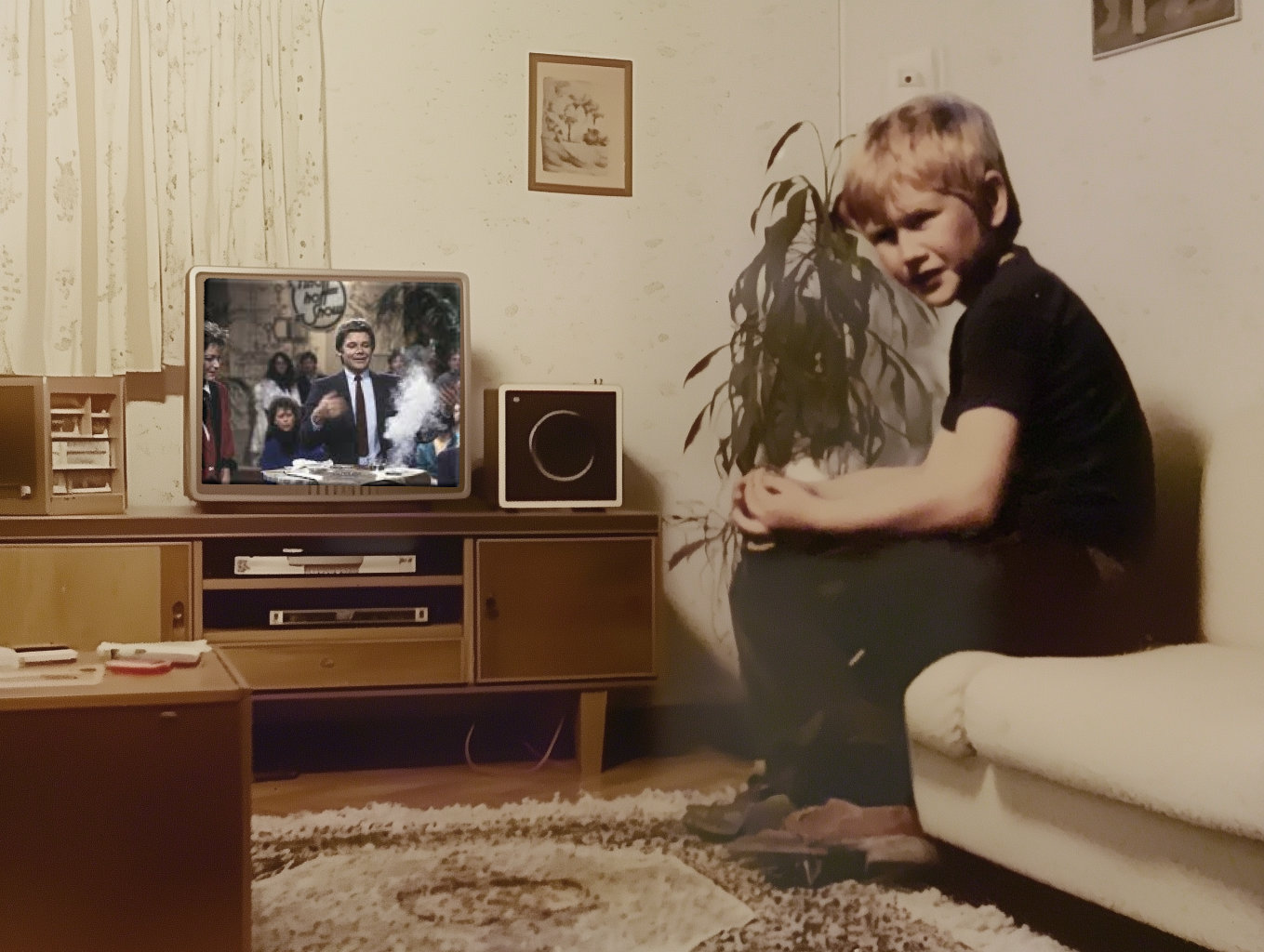
Münster, Germany 1986. It is a quiet autumn Sunday evening in our living room.
The lights are dim, the air still holds a hint of dinner, and outside the window the sky is already dark. I sit on the carpet right in front of the television, legs crossed, hands on my knees. I am eight years old and absolutely still.
On the screen there is a science show called “Knoff Hoff”.
Two hosts.
Joachim Bublath and Ramona Leiß.
A crowd behind them watching closely as they prepare another experiment.
There is a metal plate on the table and a thin cloud of smoke curling upward. Everything feels like it is on the edge of something surprising.
My father sits on the couch behind me.
He leans forward slightly, elbows on his knees, the way he always does when he is curious.
He says quietly:
“You might want to pay attention now. This one looks interesting.”
I love when he says things like that.
It makes the whole room feel like a secret is about to be revealed.
The host smiles toward the camera, puts his hand over the setup and says in German:
“Und jetzt passiert etwas, das man nicht glauben würde.”
Now something will happen that you would not believe if you did not see it.
My eight year old brain fires up like a sparkler.
I think:
“I have no idea what this is, but I want to understand it.”
There is a moment of suspended silence.
Then something pops.
Or flashes.
Or jumps across the table.
I do not remember the exact experiment.
What I remember is the feeling inside me, as if someone had opened a door in my mind I did not know existed.
My body leans closer to the screen without me noticing.
My father smiles and says:
“Everything has a cause. If you understand the cause, you understand the world.”
My thought at that exact moment:
“So this is how the world works.”
A simple thought, but it landed deep.
This was the first time I felt that curiosity could be a compass.
Am Anfang war der Wasserstoff
A few years later I discovered a book on one of our shelves.
It was Hoimar von Ditfurth’s “Am Anfang war der Wasserstoff”.
Even the title felt like a secret.
I remember running my fingers across the letters and thinking:
“This sounds like the manual for the entire universe.”
I understood maybe ten percent of it.
But I read it anyway.
Slowly. Stubbornly.
The parts I did grasp made the world feel bigger and stranger.
Not frightening.
Just full of hidden structure and invisible rules waiting to be discovered.
Looking back, this book planted two beliefs in me.
The world is far stranger than it appears.
And we can learn to understand it.
Those two thoughts became the backbone of my life.
From Hydrogen to Computers
Fast forward.
I sit in front of my first computer.
A Apple Mac machine.
A humming monitor.
A keyboard that sounds like someone breaking dry twigs.
I type my first lines of code and watch the screen respond.
There it is again.
That warm tightness in the chest.
The feeling of something invisible suddenly becoming visible.
The same sensation I had during those TV experiments.
Computers felt like physics translated into logic.
Predictable.
Structured.
Understandable.
In a world full of uncertainty this clarity came as a relief.
Bits were either zero or one.
On or off.
True or false.
Clean borders. Clear rules.
So I kept going.
Computers grew into coding, automation, systems, architecture.
All the way into my later work and eventually into Surfstyk.
Every step felt like an extension of that original curiosity.
That quiet question inside me.
“How does this really work.”
And Then The World Got Strange Again
And now we are here.
In a time when a new type of computing is beginning to emerge.
One that does not follow the clean borders of zero and one.
Quantum computing.
Suddenly a bit can be zero and one simultaneously.

Like a coin spinning in the air.
Not heads.
Not tails.
Both.
And only when you measure it does it collapse into a single outcome.
For eight year old me this would have sounded like pure magic.
Even now it feels like someone placed another experiment on the table and said:
“Watch closely. You won’t believe this if you do not see it.”
Quantum computers do not check one possibility at a time.
They explore many at once.
Three qubits can represent eight states simultaneously.
Fifty qubits can represent more states than there are grains of sand on Earth.
Three hundred qubits can represent more states than there are atoms in the universe.
And yet they are fragile.
Delicate.
Held inside gigantic refrigerators close to absolute zero.
Surrounded by layers of control systems.
Cooling hardware.
Lasers.
Microwaves.
A classical computer sitting on top like a conductor guiding an orchestra of probabilities.
It looks absurd.
But the principle behind it is familiar.
The world is stranger than it looks.
And we can learn to understand it.
This is the same realization I had on that carpet in front of the TV.
The same spark.
The same sense of wonder.
And that is what brings us to Part 2… .
Leave a Reply