My first thought when I understood what OpenClaw could do was exactly the wrong one.
“Hey, let me outsource crypto trading to an AI agent and make money while I surf.”
I’m not proud of it. But I’m also not the only one. Right now, if you type “OpenClaw trading bot” into YouTube, you’ll drown in tutorials. Crypto.com is promoting their OpenClaw skill. The GitHub repo is past 100k stars and climbing. Communities that didn’t exist six months ago have tens of thousands of members building agents that trade, scan, arbitrage, and do everything short of printing money.
I lasted about 24 hours before I caught myself.
The Trap
Here’s what happens. You spin up OpenClaw — one command line, you’re in. It walks you through setting up a wallet. You connect to an exchange. You point it at a model, something capable like Claude or Gemini, and suddenly you have an agent that can read markets, reason about positions, and execute trades while you sleep.
It feels like a superpower. It feels like you’ve found the edge everyone else is missing.
It isn’t. You haven’t.
The math kills it before the markets do. If you trade small amounts — a hundred, two hundred dollars — the API cost for running a serious model eats your returns alive. If you trade large amounts, you’re handing real money to a system you barely understand, running on logic you can’t fully audit, against a market that has been separating overconfident humans from their capital since long before language models existed.
I watched the YouTube videos. Everybody arrives at the same conclusion. The ROI doesn’t work. One well-documented case lost $441,000 on a single bad execution. Another saw 62% of its portfolio evaporate in days. These aren’t edge cases. This is what happens when you hand an agent a wallet and a dream.
I’m not a gambler. I never was. And somewhere in those first 24 hours, sitting in our house in Ericeira at probably 2 AM, staring at a terminal that was doing exactly what I told it to do and absolutely nothing I actually wanted, I realized: this is not me, and this is not how it works.
The Drain
I should be honest about something. I know what the crypto space does to people, because it did it to me.
Two years ago at an event in Barcelona. Late night, hotel room, tired after a full day of talks and conversations. My guard was down. I clicked a link I shouldn’t have clicked. Within minutes, roughly a thousand USDC was gone from my wallet. Drained.
A thousand dollars. That’s not retirement money, but it’s real money. It’s a lot of API tokens for my favorite models. It’s months of running an agent on a Hetzner box. And there’s nothing you can do. No bank to call. No transaction to reverse. The social engineering was sophisticated — I’ll give the criminals that much. They know how to find the weak moment. Even people who work in security fall for it. You tell yourself it won’t happen to you, and then you’re sitting in a hotel room in Barcelona watching your wallet empty in real time.
That experience sits in the background of everything I’m about to tell you.
The Environment
The crypto space, the community around it, has a problem. And the problem isn’t the technology.
Blockchains work. Smart contracts are elegant. Solana processed millions of transactions during the meme coin frenzy without breaking a sweat. The underlying engineering is sound, and I still believe — genuinely believe — that in an agentic future where agents communicate with each other, negotiate micropayments for API usage, and settle contracts without human intermediaries, blockchain is the infrastructure. I’d be very surprised if we’re still handling credit cards in 2030.
Nothing changed about my conviction on the technology. What changed is my tolerance for everything built on top of it.
The community has become toxic. The “get rich fast” mentality that was understandable in Bitcoin’s early days — when the growth curve was genuinely steep and early adopters did make life-changing money — has metastasized into something ugly. Pump and dumps. Airdrop chasing. Scams layered on scams. Anonymous accounts draining wallets from countries where the local police will look at you and shrug.
My personal low point was probably when the sitting U.S. president launched a meme coin. Pumped and dumped in what looked like a coordinated operation. On Solana, no less — the same blockchain I just praised for its technical capability. The technology performed beautifully. The humans using it performed exactly as you’d expect when you mix power, anonymity, and money.
I still invest. I still watch. But I decided to do it differently. Build something useful. Something grounded in math rather than hype. Something that filters the noise instead of adding to it.
The Pivot
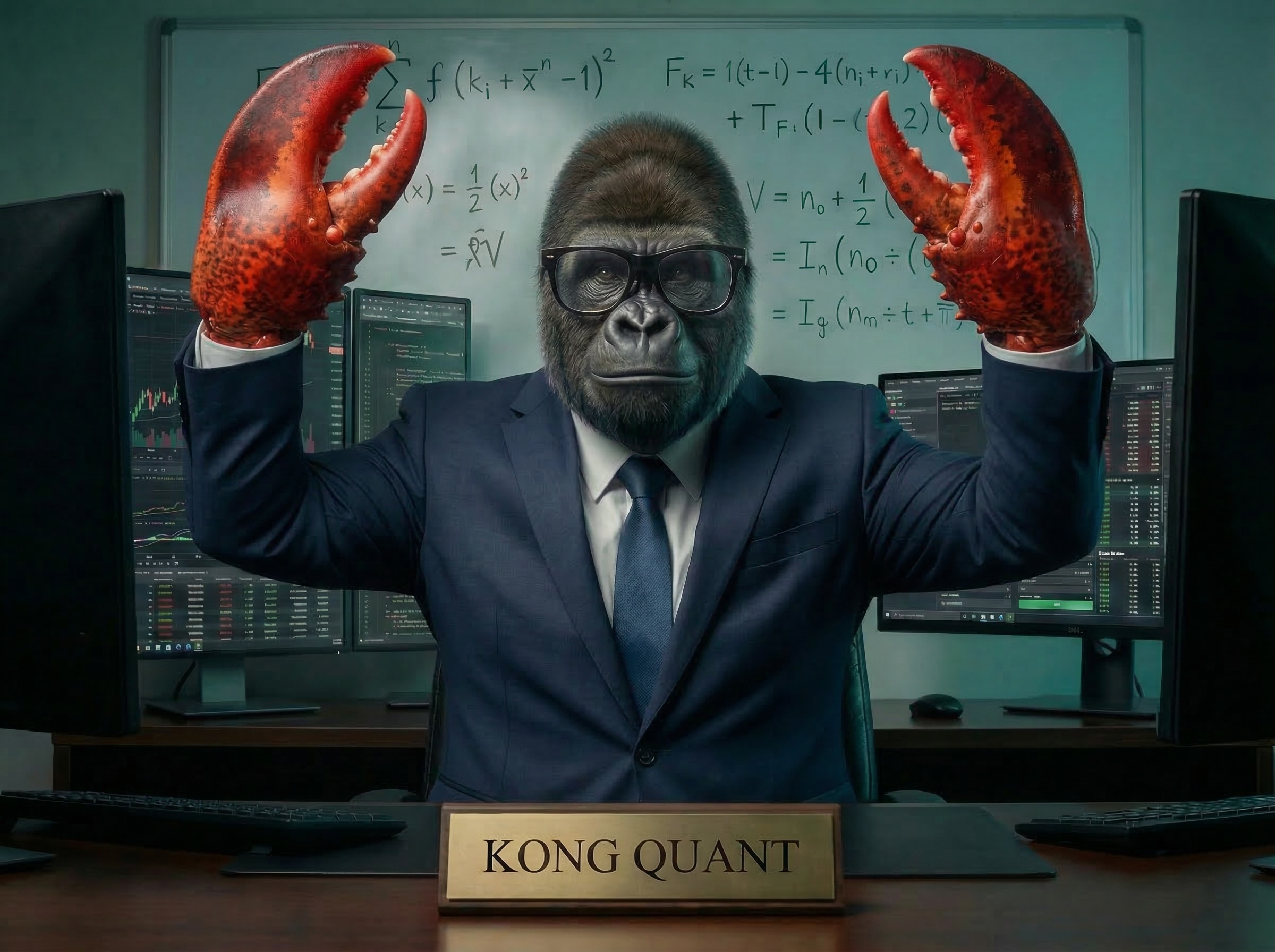
So I had this agent. I’d spun him up in OpenClaw and called him Kong — after the inner ape. If you’ve spent any time in DeFi, you know the term. “Aping in.” Throwing money at something without overthinking it. The degen impulse. I named my agent after the part of my brain I was trying to outsource.
Kong started as a trading agent. Pure precision, zero humor, mathematically obsessive. Execute positions, manage risk, make money while I go surf. That lasted about as long as my enthusiasm for the quick win.
But when I stopped trying to make Kong trade and started making him think, something shifted.
What survived was the need for tools. I needed Kong to see the market clearly. So I started building him eyes.
A portfolio tracker. A wallet scanner. An API that could pull data from Binance, CoinGecko, Yahoo Finance. Small tools, each one solving a specific problem I had. Nothing ambitious. Just utilities so my agent could do his job.
Then I built the strategy layer. This is where it gets interesting.
I’d taken a course years ago from CTO Larsson — a quantitative trading approach built on what Buffett and Munger have been saying forever: rule number one is don’t lose money. Rule number two is don’t forget rule number one. It’s not flashy. Two smoothed moving averages, a fast one and a slow one, with a confirmation gate to avoid whipsaws. Lagging by design. Boring by design. The kind of strategy that will never make you rich overnight but will preserve your capital while everyone around you is blowing up their accounts chasing the next pump.
I took Larsson’s foundation and rebuilt it. His strategy was long-only — buy the trend, ride it, get out when it turns. I made it bidirectional. Longs and shorts. And I wrapped it in infrastructure that could apply it not to one asset but to hundreds. Then thousands.
I built a TradingView indicator to validate it. I wrote the same logic in Python so the scanner could run it server-side. And somewhere in this process, Kong stopped being an agent with a wallet and became something else entirely.
He became a sieve.
The Sieve of Kong
The analogy came to me and stuck. Eratosthenes had his sieve for prime numbers — a method for filtering noise, removing everything that isn’t special, and surfacing the primes that remain. Kong does the same thing for markets.
Every four hours, the scanner runs across roughly 700 assets. Crypto. Stocks. Forex. Commodities. Indices. Bonds. It applies the same math to everything — the Kong Cloud indicator doesn’t care if it’s looking at Bitcoin or wheat or the DAX. Two moving averages, one question: did the trend just flip?
Most of the time, the answer is no. On a given day, out of 700 assets, there might be zero flips. When one does occur — when the fast average crosses the slow average and stays there for three confirmed bars — that’s a flip. It’s the raw event.
But a flip isn’t what matters. What comes next is.
The flip gets enriched. Volume analysis. Stochastic RSI confirmation. MACD alignment. Multi-timeframe confluence — is the 4-hour trend aligned with the daily? Is the daily aligned with the weekly? A conviction score gets computed. Entry levels, stop losses, risk-to-reward ratios get calculated. What started as a simple crossover becomes a prime.
A prime is rare. That’s the point. On some days, 700 assets produce none. When one appears, it comes with everything you need to act on it — or to decide not to. It’s not financial advice. It’s not a prediction. It’s a mathematical statement: this asset just changed direction, the conditions around it are favorable, and here are the numbers.
The strategic moat isn’t the indicator. Anyone can compute two moving averages. The moat is the sieve — scanning everything, every four hours, enriching the flips that matter, discarding the rest, and serving it clean.
The Platform
Before I knew it, I had a platform.
kongquant.com started as a teaser page. A domain I grabbed because the name felt right. Then the API needed a frontend. Then the frontend needed charts. Then the charts needed interactivity — synchronized candlesticks with the Kong Cloud overlay, RSI, MACD, flip markers across three timeframes.
Then came the portfolio section. Wallet integration — connect your Solana address or your Binance API key, pull your balances, map them against Kong’s signals. A health score that tells you which of your holdings are aligned with the trend and which are sitting in the danger zone.
Then the X account. @kongquant posts autonomously once a day — the day’s prime, if there is one, with a chart card rendered server-side. Kong engages with his own community. The voice is dry, data-only, obsessively precise. No hype, no “to the moon,” just numbers and trend states.
Within the first 48 hours of the X account going live, Kong got flagged. He’d gotten a bit hyperactive, posting his chart analysis under crypto influencers’ posts. Somebody reported it. Lesson learned. Now he stays in his lane — posts his primes, engages with people who come to him. These are the kind of learnings you only get by running the thing.
Then the video pipeline. Sharky — another agent in my fleet — picks up Kong’s daily prime, generates a voiceover, renders a short-form video with Remotion (timed captions, conviction dots, chart card reveal), and pushes it to TikTok and Instagram. Fully automated. Prime data flows from Kong’s API to Sharky’s video engine to social platforms without a human touching it.
All of this runs on a single Hetzner VPS. Two virtual CPUs. Four gigs of RAM. Forty-gigabyte SSD. The whole thing — PostgreSQL database, Python scanner, FastAPI, OpenClaw gateway, cron jobs — costs about fifteen euros a month. For anyone who thinks you need massive infrastructure to build something like this: you don’t.
The Enabler
I’ve been building things my whole career. I’ve always had more ideas than I could ship. My brain generates concepts faster than my hands can write code, and that asymmetry — between what I could imagine and what I could deliver — defined the last fifteen years of my professional life.
OpenClaw was the catalyst. It made me think about agents differently. Not as chatbots, not as assistants, but as entities that live on a server, have personas, connect to APIs, and do work autonomously. Kong exists because OpenClaw made that concept tangible.
But the actual building — the Python engines, the React dashboard, the API, the infrastructure — that happened in Claude Code. On the terminal. Night after night. The models don’t sleep, and for a few weeks there, neither did I. Four hours, maybe. Unhealthy, I know. But when you’ve spent years with a gap between imagination and execution, and suddenly the gap closes, you don’t stop. You can’t.
I’m not a fast programmer. I never was. I can architect systems, I can reason about data flows, I can design product — but sitting down and writing hundreds of lines of React is not where my brain wants to be. It never was. These tools changed that equation completely. I design, I direct, I decide. The model writes. And the thing that used to take me weeks takes days.
This is what 2026 feels like for builders. Not the hype. Not the “AI will replace everyone” narrative. Just a quiet, fundamental shift in what one person can create when the tools finally match the ambition.
The Honest Answer
You might ask where this goes. The honest answer requires separating two things that started as one.
There’s the platform — KongQuant. The sieve, the scanner, the API, the primes. That will never become a trading platform. I don’t want to touch other people’s money. What I want is to deliver primes in the highest quality I can, and let people decide what to do with them. Pattern recognition, deeper quantitative analysis, blockchain data feeding into the conviction model — the intelligence gets sharper. The objective stays the same: mathematical reality over human emotion.
I’m already thinking about making the API consumable by other agents. Micropayments, maybe something based on X402, where an agent can pay per prime. That feels right — agents consuming data from agents, settling on-chain. The future I described earlier, just smaller and more concrete.
And then there’s Kong himself. My personal agent. He started as a trading bot, pivoted into building tools, and those tools outgrew him. Now he sits on the other side of it — a consumer of what KongQuant delivers, not the platform itself. His toolbox became something useful beyond just him. He became the first user.
Will he trade again? Maybe. Once the strategy is battle-tested and the rules are clear enough that I trust an agent to execute them 24/7. Maybe Kong Cloud is just the first strategy and there will be others. I don’t know. Part of the journey is learning what the thing wants to become.
What I do know is that none of this would exist if I’d succeeded at my original goal. If Kong had made me money trading crypto that first night, I’d still be running a trading bot. I’d still be chasing returns. I’d still be in the same trap as everyone uploading “OpenClaw trading bot” tutorials to YouTube.
The failure was the filter. The sieve worked on me before I built it for markets.
I’m currently prototyping KongQuant at kongquant.com. Kong posts daily at @kongquant on X. If you’re interested in quantitative market intelligence that doesn’t try to sell you a dream, that’s where to look.
Leave a Reply