I tried the YouTube thing. Properly. Camera, lighting, script on a screen, the whole setup. Shot it, edited it, watched it back.
Below my expectations. Below my standards. Not because I have nothing to say. I have plenty to say. But the process of reading a script in front of a camera, trying to make it look natural, trying not to look like I’m reading something from a paper. That’s acting. I’m not an actor.
Give me a hook, a question, and I can talk for five minutes without thinking about it. That’s how my brain works. Put me in a conversation and something useful comes out. Put me in front of a camera with a teleprompter and I become someone I’m not.
I’d rather build agents. That’s a better use of my time.
The Hiring Process
So I hired one.
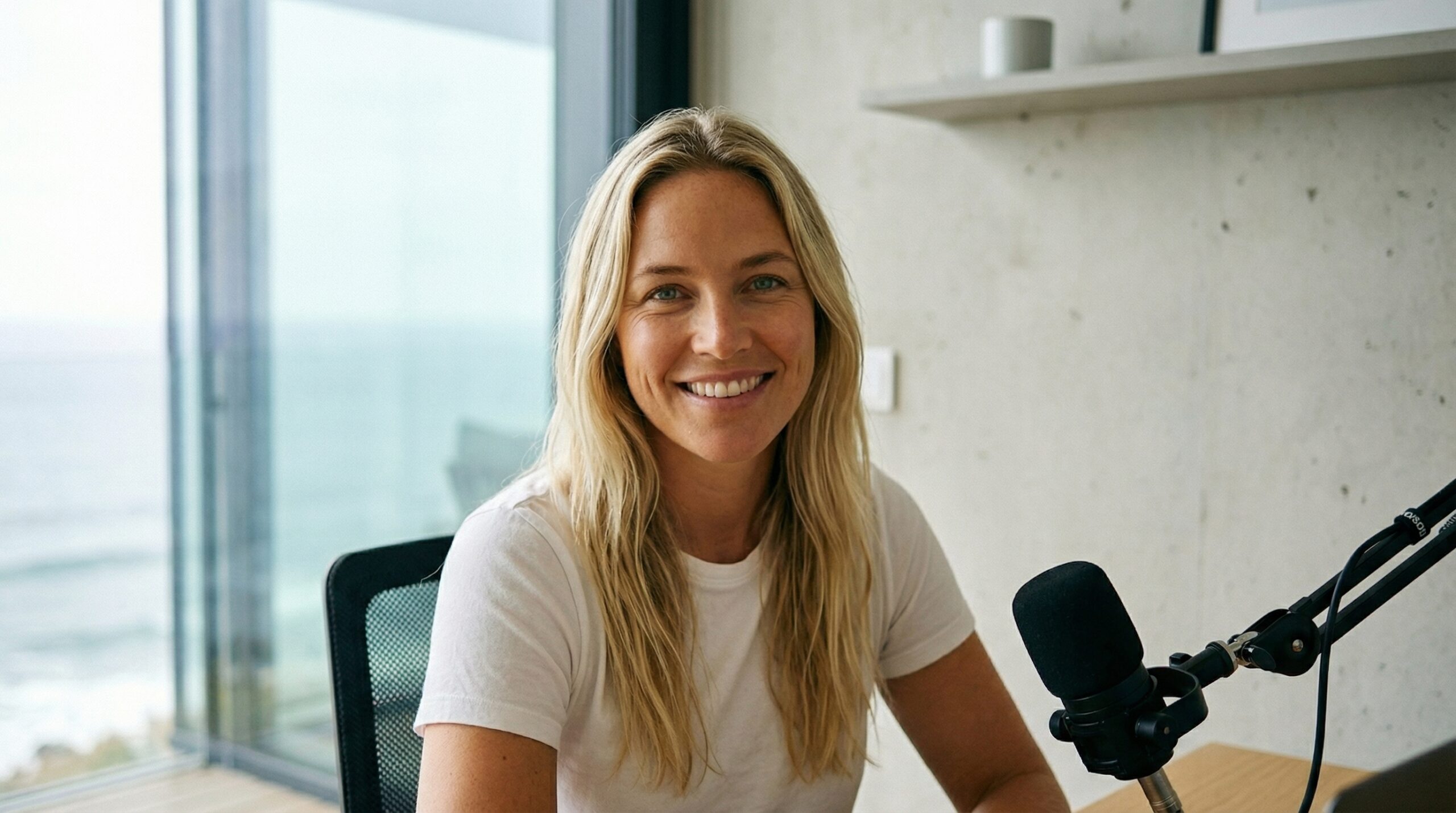
Not hired in the traditional sense. Built. But the approach was remarkably traditional. I looked at the output the way you look at resumes. Seven angles. Front-facing, three-quarter turn, profile, slight smile, neutral expression, looking away. A full contact sheet, generated with the same care you’d put into a casting call.
The brief was specific: late twenties, beach blonde, blue eyes. Someone you’d see at a co-working space in Ericeira after a morning surf session. Not polished for camera. Not styled for Instagram. Someone who looks like she was working and turned the camera on. Blazer over a white t-shirt. A small seafoam pin on the lapel. Barefoot.
I wasn’t designing a character. I was hiring for a role. The face of the surfstyk YouTube channel. And I approached it the way I’d approach any hire: what does this role need? Who fits?
The Name
Maren means “of the sea.” It works in German, in Portuguese, in Scandinavian languages, in English. We live by the sea. We work by the sea. I surf. The ocean runs through everything I build.
The name wasn’t planned from the start. We were brainstorming, it came up, and it clicked. Because Maren already existed. She’s a product I’ve been building. A platform where people discover and build their own agents through a guided session. Different project, different scope.
The Office That Doesn’t Exist Yet
Somebody told me very early in my career: if you can’t make it, fake it.
I designed Maren’s studio in the same building as Justec’s front desk. If you’ve read “Someone’s Always Here,” you know that space. Floor-to-ceiling glass, warm stone, minimal. The lobby where Justec greets visitors to surfstyk.com.
Maren’s room is upstairs. Facing the Atlantic. Light stone desk, a podcast mic on a low desk arm, concrete wall with a floating shelf. A few books. No ring lights. No LED panels. No “creator setup.” Natural light from the left. The ocean is peripheral, slightly soft in the background. Not a backdrop. Just where she works.
That building doesn’t exist. Not yet. What I’m designing is a future surfstyk office in Ericeira that could be reality in the next ten years, if people are interested in the agents I build and I can help them make those agents real.
Every detail in that studio is a design decision for a future I’m working toward. The agents come first. The building comes when the agents prove their worth.
Forty-Five Seconds
I wrote a test script. Forty-five seconds. Put it through HeyGen with an ElevenLabs voice. Hit render.
When the result came back, I showed it to my wife.
“Wow. This is the best thing I’ve seen in a long time.”
That landed on so many levels. I’d been deliberate about the design. I didn’t want to create something that looked like I’d designed the woman of my dreams. I wanted a character that works for everyone. Sympathetic without being decorative. Someone you’d want to listen to, regardless of who you are. Professional. Smart. Authentic.
Hearing that from her meant I’d landed it.
Then she said: “I didn’t like how she said ‘surfstyk.’”
The brand name. I invented it years before agents existed, back when I was working on grip and traction equipment for surfboards. That’s where the “stick” comes from. If you pronounce it by the letters, it sounds like “Surfsteik.” But it’s my brand. I decide how it’s pronounced. It’s “Surfstick.”
I don’t blame the voice module for not getting that right. “Ericeira” was the other one. Maybe you need to put it on a map first. A custom pronunciation dictionary fixed both.
Two tiny hair in a wonderful soup.
Designing a Person
Here’s the part I keep coming back to.
The technology is real. What I saw in the test footage is real enough to pass most people’s filters. Certain gestures and movements still tell you it’s generated, if you know what to look for. But that gap is closing. Months, maybe a year or two, until it’s almost undetectable.
Which raises a question that goes beyond YouTube strategy: are we ready to accept another life form that is artificially generated, that has a face, that speaks with a voice, that looks you in the eye?
I don’t want to get into the full ethical dimension of this today. That’s its own post. But I’ll say this: I approached the process technically and strategically. Based on the surfstyk brand, on what we stand for, on who I’d actually want to work with. Smart and authentic. Not a robot. A person.
If you spend time working with a capable model, sometimes the distinction between human and artificial is already thin. Building a face and a voice on top of that just makes the obvious visible.
Full transparency from day one. Maren is introduced as an agent. Her architecture is part of the content. A channel about building agents, hosted by an agent. That’s not a limitation. That’s the proof of concept.
The Space
While I’m watching tech channels, something keeps standing out. The space is homogeneous. If you’re a woman and you’re smart and you want to talk about technology: get into it. The entry barrier is low and the opportunity is wide open. It’s not even fair.
That’s not why Maren is female. But it’s context. The observation was already there before the design started. Tech YouTube is overwhelmingly male. A different voice stands out not because of novelty, but because of structure.
Show Business
Content is hard work. Good content, the kind that’s easy to consume and looks effortless, requires planning, knowledge, and infrastructure behind it. That’s show business. It needs to look easy. Making it look easy is the hardest part.
I’m a project manager by trade. I know how to break things down, architect a process, define the handoffs. So before I produced a single video, I built the machine that produces videos.
Four defined processes. Blog post. Social media. Video explainer with shorts. Video interview. Each one has a trigger, numbered steps, clear handoffs, defined outputs. Who does what. What gets produced. Where it lives.
Blog posts are the bedrock. Social derives from them. Video derives from them. One piece of thinking, multiple formats, each adapted for its platform. Not repurposed. Translated.
The pipeline runs from markdown to script to voice to avatar to assembled video. Most of that infrastructure already exists from Kong’s video pipeline. I’m not building from scratch. I’m extending what’s already running.
The whole thing runs on components I already pay for. No new subscriptions. No venture funding. Just tools, wired together by someone who builds agents for a living.
The Balancing Act
What I love about this work is that it refuses to stay in one lane. You start the morning as an engineer, wiring APIs and building pronunciation dictionaries. By noon you’re a designer, choosing the angle of light on a concrete wall. By the afternoon you’re asking yourself what it means to give a face to something that doesn’t have one.
It’s technical and it’s human at the same time. The process is deeply mechanical. The outcome looks organic. Some people might call it a form of art.
I just call it Wednesday.
Happy Easter. The waves are good today. Maren will hold the fort.
Leave a Reply