A LinkedIn comment under a video I posted: “Too obvious AI for me, we’re looking for a real person to work with.” That comment is my favourite kind. It asks the question I have been trying to answer for ten years.
The video was about Maren, the YouTube host I had hired for surfstyk. I shared it on LinkedIn with a short note offering it as an option for other founders who needed a presenter and could not justify the cost or coordination of a real one.
A co-founder of a B2B software company replied. Real business behind him, paying customers, marketplace listing, the kind of profile that signals seriousness. His comment was four words long.
“Too obvious AI for me, we’re looking for a real person to work with.”
I read it on my phone, the way I read all comments. I was not annoyed. I was grateful. That comment was the cleanest version of an instinct I have heard in a hundred different shapes: from German clients, from European founders, from people in my network. We want a human. We are not even open to the conversation about what an agent could do.
I understand it. I have built this entire business on the answer to it. But I cannot reach the people I want to reach unless I say the answer out loud. So this post is the answer.
Start with why
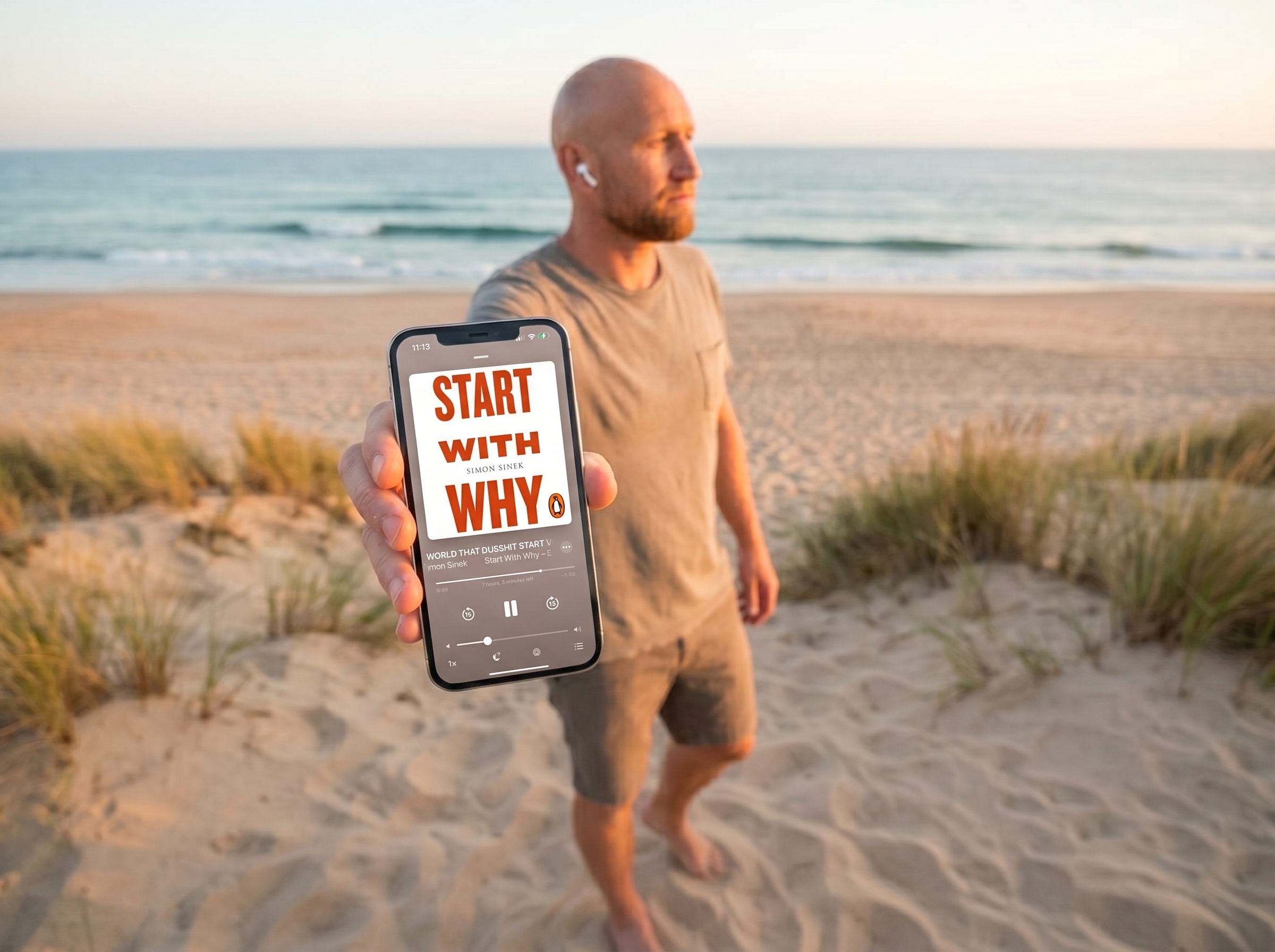
Simon Sinek wrote Start with Why in 2009. Most business owners I work with have read it. The ones who haven’t, should. The argument is simple. People do not buy what you do or how you do it. They buy why you do it. The brands that succeed are the ones that articulate the why first and let the what and the how follow.
Most founders can answer what they do and how they do it without hesitation. Their pitch deck has a slide for each. The why is where it goes quiet. It sounds either fake or self-important when spoken out loud, and most people choose to skip the question rather than say something embarrassing.
I am going to say the embarrassing thing.
I am not doing this for the money.
I should qualify that immediately, because I do not want to sound like a monk. I like money. I want a healthy cash flow. I work with clients who want one too, and I help them build it. Money is fuel. It is not the why.
The why has to do with the kind of business owner I want to help, and the kind of help I want to give them.
Why Portugal
Ten years ago I moved to Portugal.
If your main driver is money, you do not move to Portugal. Portugal is wonderful. The people are warm, the ocean is honest, the food is real. But the salaries are low, the bureaucracy is slow, and the path of least resistance for a German engineer was to stay in Berlin or move to London. I went south instead, and somewhere along the way the deeper answer to why was being made on my behalf, even though I could not articulate it yet.
The years since have been a search for what that why actually is. surfstyk happened. Grip and Traction happened. studenta happened. Each project sharpened the answer a little. Each project was a chance to use the technology I love for something past the invoice.
What I have landed on, after ten years of looking, is this. I want to help the kind of small business that has more ambition than headcount. The kind that ships something good and cannot scale because the busy work is eating the founder’s calendar. The kind that should be able to compete and currently cannot.
What I see
Two patterns show up in almost every conversation I have with business owners.
The first is admin. The founder spends three hours a day on email, scheduling, status updates, intake forms, support tickets, and every other task that does not require their judgement but does require their attention. They cannot hire for it because hiring for low-skill, high-friction work is the worst kind of hire. You bring on someone who interviewed well. The first weeks go fine. By month three the performance declines. By month six you are negotiating an exit. If they are on a permanent contract in Germany, you may be negotiating it in court. The loyalty you hoped for is rare and the friction you feared was unavoidable.
The second is social media. They are excellent at their craft. They started a blog, an Instagram, a LinkedIn, with the right intent. Then the calendar took over. Posts go out in bursts every six weeks, then nothing. Their best work is invisible because they cannot keep a regular cadence and their voice is buried under the noise of competitors who can.
Agents resource both of these. Quietly, predictably, without contracts, sick days, or court dates.
I will not name the client, but I have one where messages from a workforce flow through WhatsApp into a dashboard and an HR system overnight. The owner used to wake up at 6am to check whether the shift was complete. Now he doesn’t. The shift confirms itself before sunrise. The dashboard shows what needs his attention by the time he is at his desk.
That is what quality of life means in this work. Not a feature list. A founder sleeping until the alarm goes off.
The fear
Back to the comment. Too obvious AI for me. We’re looking for a real person.
I think about that founder’s choice. He wants a presenter for a YouTube channel, on brand, who knows his product, who shows up on a schedule. The real-person version is not impossible, but the unit economics are unfriendly. The presenter has to learn the product. They have to sound on-brand. They will be expensive if they are good. And if they are good, they will move on, and his channel will go back to square one.
The agent version is not perfect. Anyone can tell it is an agent. That is the cost. The benefit is that she will not move on, will not get sick, will not unlearn the brand, and will be there next Wednesday.
He chose the cost. That is fine. Most founders will choose the cost for now, the same way most founders chose to keep paper invoices long after the accounting software arrived.
The deeper objection underneath that comment is the one I want to address. It is the fear that agents are taking work away from people who deserve it. I have not seen that. I have seen agents take work away from work that nobody wanted in the first place. Email triage. Scheduling. Form filling. Shift confirmations at 6am. The kind of work that drags down the loyal humans on a team as much as it drags down the owner.
There is a quieter argument worth making here too. Human attention has become the scarcest resource in our economy. UC Irvine’s Gloria Mark has tracked the average focused attention on a screen down from two and a half minutes in 2004 to forty-seven seconds today. A 2025 meta-analysis in Psychological Bulletin tied short-form video use to measurable decline in attention and inhibitory control. The platforms that small businesses must be visible on are the same platforms designed to extract attention at scale.
That is the Catch-22. You cannot ignore them. Being on them costs you the focus you need to do your actual work. Agents do not solve that fully, but they reduce the surface area you have to expose to it. They let you be present without losing the time and attention you need to think.
Why
That is the work I do. This is why I do it.
If I were standing in front of Sinek’s golden circle, the version he himself drew on a napkin in 2009, the why I would write at the centre is not money.
It is this. I want small businesses to have what previously took scale. Room to breathe. Time to think. Presence without exhaustion. A team that includes the colleague who does not need a payroll and who does not get sick and who confirms the shift before the founder’s alarm rings.
That is what AR departments are for. That is the work. That is the why.
Leave a Reply