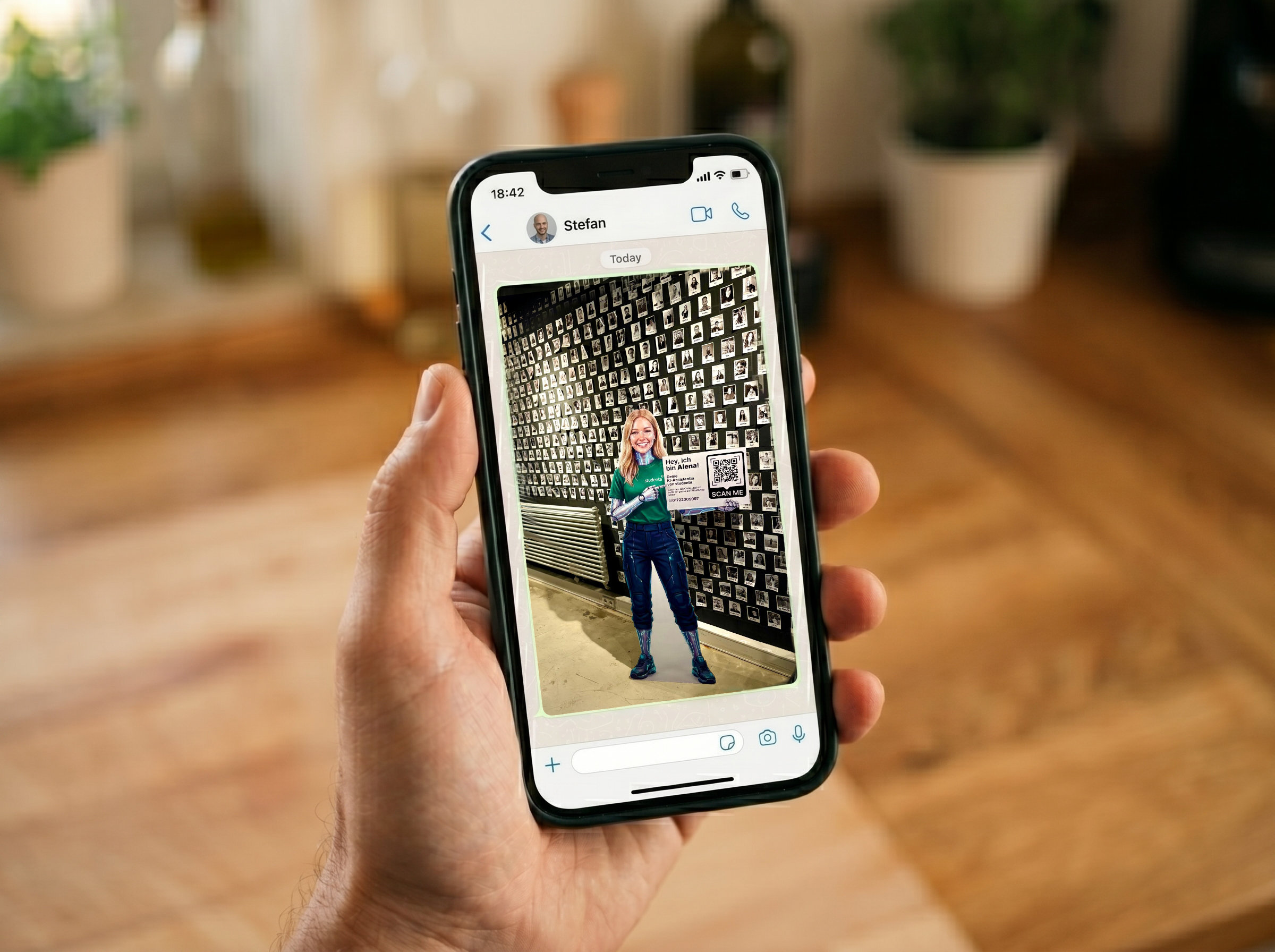
It’s a Tuesday. My wife is heating olive oil. My son is setting out the parmesan, the yellow block, not the pre-grated kind. Pasta with pesto is the house dinner, the one we cook when the week is normal and nothing is on fire. My phone is face down on the counter. I don’t usually read messages at dinner.
This one I read.
It’s from Stefan, a client of mine in Münster. He’s co-CEO of studenta, a student job platform with 130-plus people on the rolls. Stefan also runs an events business, the kind where he builds physical installations for parties, trade shows, and product launches. He thinks in rooms and booths, not screens and dashboards.
The photo shows a life-size cardboard standee of a woman. Green studenta t-shirt. Robotic arm. Tech-panel pants. A paper sign with a QR code: Hey, ich bin Alena! Deine KI-Assistentin von studenta.
She’s standing in front of the teamworx wall. Studenta’s internal staff photo board. Hundreds of black-and-white polaroids of employees, each with a name pinned beneath it. Bennet. Liam. Sarah. Aaron.
And in front of them, her. Alena. Life-size. Standing where the team is shown.
I showed the photo to my family. We were proud.
The wall
I built Alena. She’s been live at studenta since fall 2025 and really got into stride when the new semester began. She handles onboarding, CV analysis, sick leaves, day-to-day staff management. She runs on WhatsApp via Meta’s official API. Students have her phone number. Staff can reach an internal variant. She’s been through thousands of interactions without a major failure.
But that’s not why Stefan sent the photo.
He sent it because he had placed Alena in front of the team wall. Not in the office lobby as a mascot. Not in the marketing materials as a character. Not on the software page as a feature. In front of the team. The wall with photos of the actual people who work at studenta. The same wall that has Bennet and Liam and Sarah and Aaron. That wall.
I don’t think he realized what he was saying.
What the photo was really of
Most founders deploying agents keep them in an “AI” corner. The automation stack page. The tools section of the product tour. A separate vertical on the pitch deck labelled “Emerging Tech.” Intended or not, the layout sends a message: these are things, and they sit elsewhere.
Stefan did the opposite. He gave Alena a body. He gave her a phone number. He placed her at the staff gallery.
That is a philosophical claim made in cardboard. She is staff, not software. She is a colleague, not a tool. She belongs in the org chart, not the tech stack.
Standing in the kitchen with pasta water rising behind me, I looked at the photo and realised I had been making that same claim for two years without saying it out loud. I had been treating Alena, Justec, Sharky, and Funley as colleagues. I wrote their standing orders like job descriptions. I tracked their performance like performance reviews. I designed the handoffs between them like org charts. I had been running a department.
I just had not named it.
The name is Agentic Resources. The role that runs it is Chief AR Officer. I sat down the next morning and wrote the job description. It matched what I had been doing for two years.
Five questions every company with agents has to answer
Every company that has humans on the payroll has an HR department. Human Resources. A discipline, a chief, a set of responsibilities. Strategic workforce planning. Organisational culture. Performance and compensation. HR technology. Compliance and risk.
Every company that has agents on the payroll will need an Agentic Resources department. The same five questions. The same discipline. A different workforce.
Strategic Agent Portfolio Planning. Who is on your roster, why, and how is it growing? Alena joined studenta in fall 2025 with a narrow scope. Her scope has grown every month since. Onboarding. CVs. Sick leaves. Staff management. Each expansion is a hiring decision. It deserves thought, not just a feature request.
Agent Ecosystem Design. How do agents collaborate, where are the handoffs, how do humans stay in the loop, and what happens at the edges of an agent’s contract? Alena has a clean answer to that last one. A 40-something visitor to the studenta site once scanned her QR code and tried, half-jokingly, to apply for a job. She told him applicants have to be matriculated at a German university. He admitted he was not. She brushed him off, politely but firmly. “Sorry, I can’t help you here. Maybe come back at another time.” She acted within her contract. No hallucinated enthusiasm. No scripted apology either. She told the truth and moved on.
Agent Performance & Economics. What does she actually ship, and what does it cost to keep her running? Thousands of interactions. Zero major failures. Real latency budgets. Real compute bills. A CHRO optimises payroll. A CARO optimises agent runtime. It is the same discipline, measured differently.
Agent Platform & Integration. Where does she operate, and what does that cost in friction? Alena runs on WhatsApp. Getting a production WhatsApp implementation through Meta is a genuine pain. Every time I think it should not take this long, I remember why it takes this long. Meta makes scamming customers hard to do at scale, and that is the correct priority. Security friction is a feature.
Agent Safety & Compliance. How does she stay in-bounds, honest, and safe under pressure? The disclaimer on any agent, Alena included, is that she can make mistakes just like a human colleague can. Intelligence, artificial or otherwise, does not guarantee getting everything right. The boundaries are set by design, reviewed continuously, and published internally so humans know what she will and will not do.
These five questions are not novel. They are the exact CHRO job description with the word “human” swapped for “agentic.” Which is the point. This is a familiar discipline applied to an unfamiliar workforce.
What the students see
The part of Stefan’s photo I keep coming back to is not the standee. It is the space around it.
The standee has been in the office for months. Alena stands there every day. The students walking past her, people in their early twenties, do not treat her as a novelty. They do not photograph her. They do not ask where she came from. They do not explain her to each other.
For them, she is just part of the office.
They grew up with agents the way I grew up with television. It is not a big deal. It is the furniture. They will be the ones building the next generation of companies, and they will think about their rosters differently than most of us do today. They are not going to have separate “AI” departments because they are not going to see the separation. A colleague is a colleague.
My generation is the one still working out the vocabulary. AR is the vocabulary I am offering. Take it, leave it, improve it. The name will get stolen. I would rather that happen with a reference post on the internet than without one.
A department opens
Stefan placed Alena in front of the team wall. He did it on his own, because that is where she belonged. That is a better kind of design decision than most of the ones I have made in this field.
Maybe in five years every org chart has an AR department. Maybe Chief AR Officer is a standard C-suite title. Maybe not. Either way, Alena is staying with the team. The photo is on my fridge. The discipline has a name now.
And studenta’s next hire, the one after the next human, will also join them.
Leave a Reply