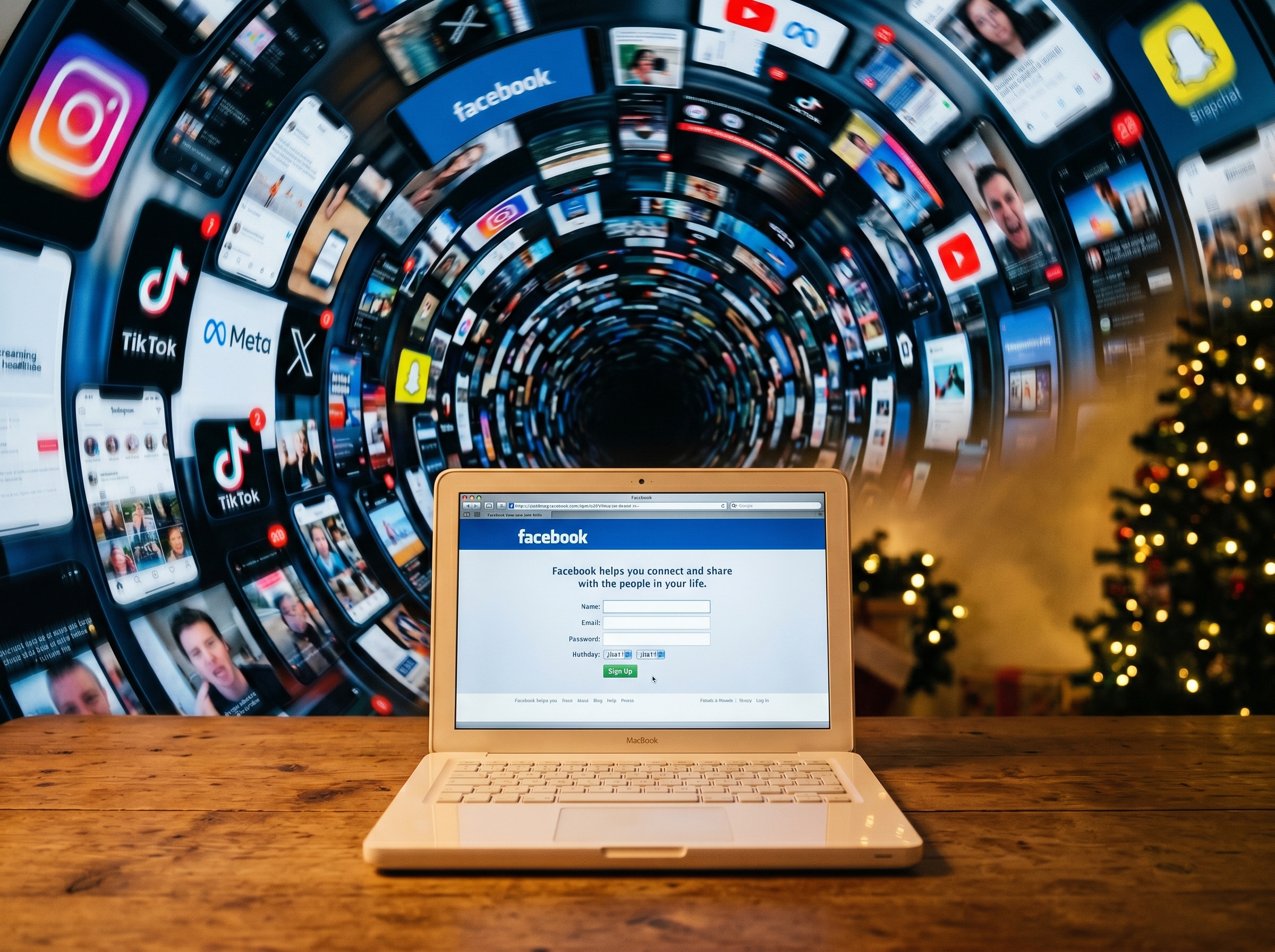
Christmas 2007. The presents had been opened, the family celebration was done, and the quiet days between Christmas and New Year had settled in. A friend had been recommending this new thing called Facebook. I finally had the time to try it.
I sat down at the computer. December 30th, 7:05 p.m., forty-two seconds past the minute. The platform stamped the moment. Facebook helps you connect and share with the people in your life, the homepage said.
I believed it. I had every reason to believe it. So did everyone else who signed up that year.
Many years later, on a beach in Portugal, walking the dog at sunset while my son was at sports, an old question surfaced for the first time in a long while. Why did I sign up to any of this in the first place? I went back to the archive afterward, and the platform had everything kept in place. Every status, every comment, every photo from the decade and a half since. To Facebook’s credit, they kept that promise. If a friend or an enemy ever wants to find out who I was, the receipts are filed.
The other promise did not survive.
Read that tagline again. Then open Instagram, or X, or TikTok, or whichever feed you’re handed today. Count how many of the first ten posts come from people in your actual life. People you’ve shared a meal with. People whose voice you’d recognize on a phone call.
The drift isn’t subtle. It isn’t really a drift. It’s a one-eighty.
The Slot Machine in Your Pocket
The mechanics aren’t a mystery. They were designed.
The same variable-reward principles refined over decades inside Las Vegas slot machine cabinets, the ones that turned the casino floor into the most efficient attention-extraction system humans had ever built, were ported into the eternal feed. Pull, reveal, dopamine. Pull, reveal, dopamine. The interval is unpredictable on purpose. That’s what makes it sticky.
Natasha Schüll’s research on machine gambling (Addiction by Design) reads like a blueprint for what every algorithmic feed eventually became. The Center for Humane Technology, and the Your Undivided Attention podcast that came out of it, traced this lineage out loud years before it was fashionable to say so. That podcast was where I first heard the case made cleanly, three or four years back, and it landed.
Attention has become the scarcest resource in the economy. That was already true when I first heard it framed that way. With agents generating content at zero marginal cost and flooding every channel now, it’s even more true.
The Most Ingenious Part Is the Name
Social media.
It sounds like infrastructure for human connection. It sounds like the village square scaled up, the dinner table extended.
What it actually delivers, mostly, is the opposite. Silos. Bubbles. Two people at the same table, both staring down. A feed populated by strangers performing for strangers, optimized for the next pull of the lever.
I’ve been jokingly calling it asocial media for a while. The name won’t stick, and renaming a category this entrenched is probably impossible at this point. But the recognition has to land somewhere, because the word itself is doing work to keep us from seeing the thing clearly.
What This Means If You Run a Small Business
Here’s the part I keep coming back to with clients.
Likes don’t pay rent. They never did. The number on the screen is a vanity signal that the platform itself uses to keep you posting. Meaningful relationships with the small group of people who actually buy from you and refer you, that’s the asset.
And here’s the harder claim, the one I’ll defend from observation across enough founders to call it a pattern: people who buy premium services don’t live in the short-form feed. The software developers, the craftsmen, the engineers, the operators who write real-money cheques. They read books. They watch films, not feeds. They have attention spans that survive past three seconds. When they want to do business with you, they want to see what you do, how you do it, why you do it. They want to read.
The implication for an SMB or a solopreneur is uncomfortable. Optimizing for short-form virality may be optimizing for the audience that won’t buy from you.
Twenty years from now, I think we’ll look at how this generation used short-form video the way we look at 1950s photographs of doctors examining patients with a cigarette in hand. Gen A is already shifting, voluntarily, to other ways of communicating. Gen X, my own cohort, looks like the most caught. The thirty-to-forty bracket is where I see the deepest scroll holes.
The Agent Caveat
This is the part where I have to be careful, because I build agents that run social media for entrepreneurs. The pitch is genuine. Production automation that lets a founder be present on the channels where prospects scroll without spending half the day there. Asset generation, scheduling, format adaptation, the heavy lifting of being everywhere at once. Agents are good at all of this, and most small businesses should be using them.
What agents should not do, in my opinion, is the engagement.
The reply thread. The DM. The thoughtful note under a stranger’s post that turns into a real conversation. That part is where the value of being on the platform actually lives, and the moment a machine takes it over, the channel starts feeling exactly as hollow as the rest of the feed.
So the rule I work to: agents handle the production. Humans handle the connection. Otherwise you’ve just automated the asocial part, and the people on the other end can feel it.
Hate the Game, Still Play It
I’m not telling anyone to delete their accounts. We’re nowhere near the point where a small business can afford to be invisible on the channels where customers still scroll. You can hate the game and still have to play it.
The move I push, for myself and for the founders I work with, is to play it without getting pulled under.
That means owning your real platform first. A blog on your own domain. A long-form video where evergreen quality earns the time it takes to make it. A newsletter you control end to end. Don’t build a house on borrowed land. The land has been moved before, and it will be moved again.
The platforms are presence. Your blog is the home address.
The Horizon
Somewhere ahead of us is the moment the cigarette parallel becomes obvious in the public conversation. The studies will catch up. The lawsuits already are. The cultural permission to say this design was always predatory will arrive, late, the way it always does.
The businesses that will be standing on the other side of that recognition are the ones that, today, are quietly building on land they own, with relationships they earned, in formats their actual customers have the attention span to consume.
Stop calling it social media. It hasn’t been for a long time.
Leave a Reply