The old MacBook took a while to wake up. I had it open next to the machine I actually work on, digging through archive folders I had not touched in years, looking for a file I was not certain I still owned.
Nimiq had opened developer accounts for their Mini Apps competition, and the sign-in wanted a login file. I knew I had made a Nimiq account somewhere back in 2021. I had completely forgotten what that involved, where I had put the credential, or what it even looked like.
It took longer than it should have. And when I finally found it, I sat there for a second, because it was not a text file. It was not twenty-four words in a note I would have had to keep safe for five years.
It was a picture.
A credential you can look at
A Nimiq login file is a small image with a QR code printed on it. Inside that code sits your private key, encrypted with your password. That is the whole design.
Compare it to what most of the industry settled on. Twenty-four recovery words, in plain text, that you are told to write on paper and never photograph, never type into anything, never lose. The words are the key. Anyone who reads them owns your money. The security model is a piece of paper and your discipline.
The login file inverts that. The key is inside the picture and the picture is locked. Without the password it is a useless square of pixels, which means it can live in a cloud folder, in a password manager, on a machine in a drawer, without being a liability. To sign in on a new device you drag the image in, or you hold it up to a camera and let the camera read it.
That is not a small usability trick. That is someone looking at the single worst part of self-custody and refusing to accept it as a law of nature.
Five years later, on a different machine, I dragged that image into a login screen and my developer account was created. The thing just worked.
Why I was already a fan
I found Nimiq in the 2020 to 2021 run. Those were the golden days, when you watched a Coin Bureau video and aped into a token hoping it would 100x. Only the people who were there can relate.
As an investment, NIM has not been my finest hour. As a project it is alive and kicking, and it has spent the years since doing the same stubborn thing it was doing when I found it: taking the parts of this technology that scare normal people and quietly removing them.
So when the Mini Apps competition showed up, there was not much of a decision to make. Four weeks. Build something that runs inside Nimiq Pay. I was in before I knew what I was building.
The idea came from the bathroom
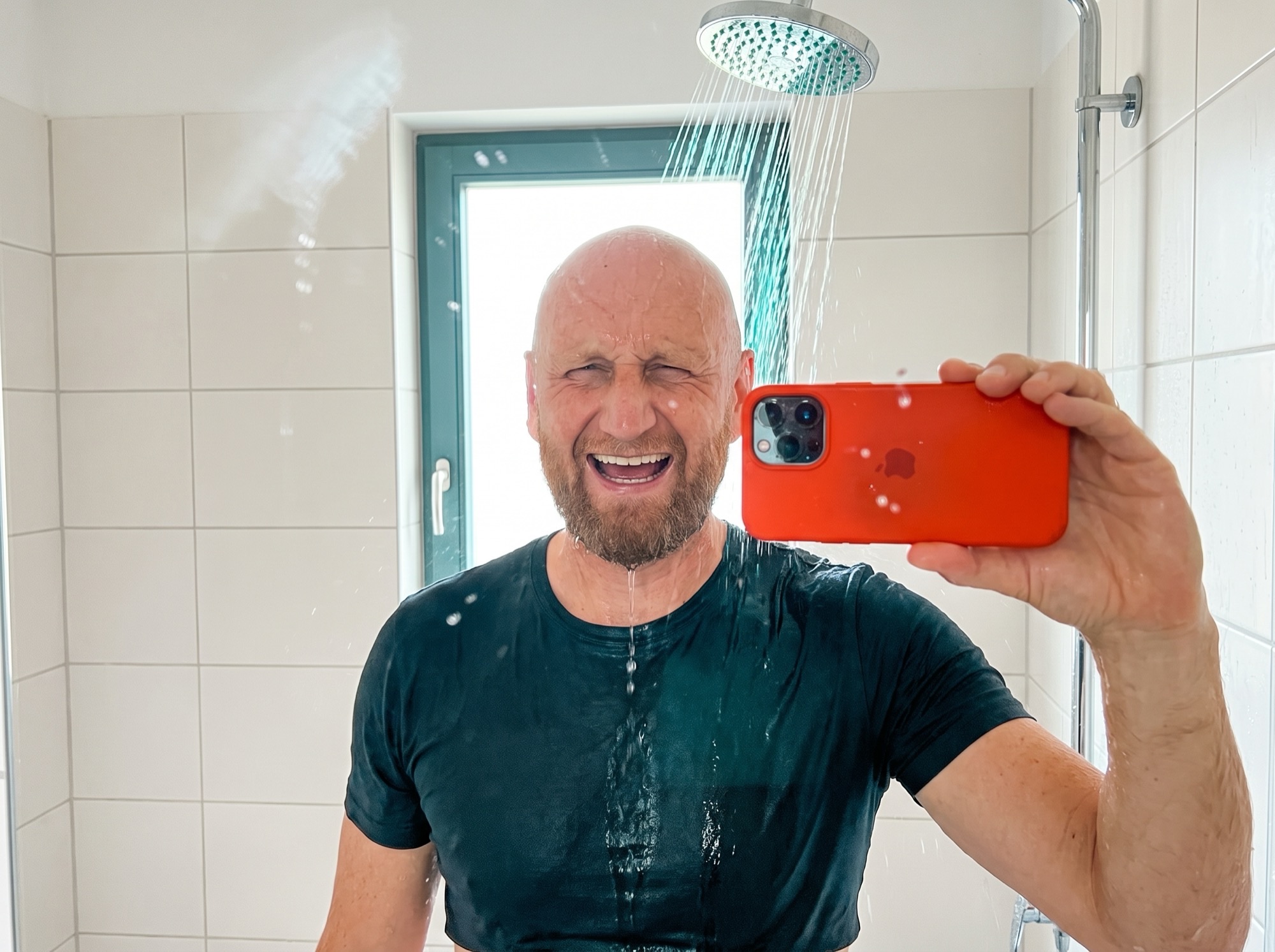
My wife and I had decided we were going to take a cold shower every morning. No protocol, no hashtag, no app. Just the two of us agreeing that this is a thing we do now.
It stuck. And the reason it stuck has almost nothing to do with willpower. It stuck because the other person knows.
That is the entire product.
Stakes is a social commitment game. You pick a goal, put a small amount of NIM on it, and set a length. You send the pledge to your crew and they stake the same amount to join. Then you check in once a day, every day. Miss the window and that day’s slice of your stake is gone. Finish the week clean and you get all of it back, plus a share of what the quitters left behind, plus a small bonus.
The claim on it is: an app to quit quitting.
The money’s job is to be at risk, not to be won. It is working capital for your willpower.
The feature I deliberately did not build
The obvious request writes itself. Verify the check-in. Put a camera on it, put a model behind the camera, have something confirm the run actually happened. I build agents for a living. Every tool for that is already on my shelf.
I left it off on purpose.
Partly because it does not work. If someone wants to cheat this, they will cheat it, and every layer of verification you add is just a slightly more interesting puzzle for the person who was going to cheat anyway. You cannot engineer your way out of a character problem.
Mostly because it is the wrong shape. Stakes is humans with humans. The moment a model becomes the referee, the thing your friends were doing stops being trust and starts being compliance. Your crew is not there to audit you. They are there to know.
My hunch is that the check-ins carry more signal than any verifier would. The way a person writes about day four of something they actually did is not the way they write when they are covering. Your friends can read that. A camera cannot.
So the split is deliberate and it is the brand: the money is handled by systems, the truth is handled by people.
The other decision: not EVM
The second thing I ruled out early was building on an EVM chain.
It would have been the default move. But look at what it costs a normal person: a different wallet to install, a gas balance to top up, a token to acquire before they can use the thing they actually came for, and a native confirm dialog full of vocabulary designed by and for people who already understand it. Every one of those is a step, and every step loses people. The join flow is the whole growth mechanic here. I could not afford to leak users at four separate gates before anyone had made a promise to anyone.
Nimiq Pay does not have that problem. The money is NIM, it moves inside an app the person already has open, and every payment is one native tap. No gas. No fees. No seed phrase. No moment where the app has to teach you a new concept before it can do the thing you wanted.
It feels like money moving between friends. There just happens to be a blockchain underneath.
Two phones and one cent
At the end of June I ran the whole loop on real mainnet money, with two phones on the desk: an iPhone and an Android Seeker. Create, join, the days compressed down to minutes, settle. Then I watched the payouts land in the Nimiq Pay wallets. Thirty-five NIM to one, sixteen point six seven to the other.
I should be honest about what “real money” means there. Twenty-five NIM is about a cent. Nobody is retiring on this.
But that is not what a proof is for. The proof is that the pipe holds end to end, on two operating systems, with the settlement math and the on-screen preview coming from the same function so they cannot disagree. The amounts are a slider. If the mechanism is sound, you raise the stakes, and the stakes are the product.
I sat there watching two phones light up over about one and a half cents and I was properly, unreasonably proud.
Wednesday
I had a rough version working well before the build window even opened, and then I went quiet for three weeks while other work took over.
Then on Wednesday I presented on the Sip and Ship call.
I was not ready for what came back. My screen filled with red hearts, more of them than I could follow. The Nimiq team gave it a genuinely warm welcome, and the community picked it up afterwards on Skool.
That reaction is the only reason the last four days look the way they do. Yesterday was fourteen hours, and not all of them were good ones. I made a handful of changes I had to roll straight back, which cost me half a day. The rest went into UX polish, a fresh set of screenshots, and a second version of the pitch film, because the first one never actually told you that the card you send is the invite.
I am writing this on submission day, with a desk full of phones and laptops and not much left in the tank. The submission goes in, and then this goes out.
Where it goes next
Three things, and none of them are in the version being submitted.
The stake currently sits in an escrow I operate. That works, and I would rather be honest about what it is than dress it up. But it is not where this should end. What I want is for your stake to actually be staked, delegated to a validator for the length of your challenge. Two things happen then. Your money secures the network while you are busy not quitting, and it earns something. Very little, at today’s numbers. “Very little” has a way of not staying that way.
Second, the sharing. Right now a check-in is text. It should be a photo or a short video. You are reading a book in a library, you take a selfie, that is the check-in and it is also the thing you post. The card the app hands you is already the most important object in the product. I want the daily moment to feed it.
Third was not my idea. It came out of the Sip and Ship call: online courses. People buy them and never finish them, which is one of the most reliable failures of intent anyone has ever monetised. That might be a Cycle II conversation.
The ask
If any of that sounds like something you would run with two or three friends, the listing has the film, the screenshots, and the way in:
I did my part.
One last thing. In the app, on the create screen, there is a row of goal templates you can pick from. One of them has a shower emoji on it. It says “Cold shower.” The hint underneath says “brrr.”
That one is not a placeholder.
Leave a Reply